

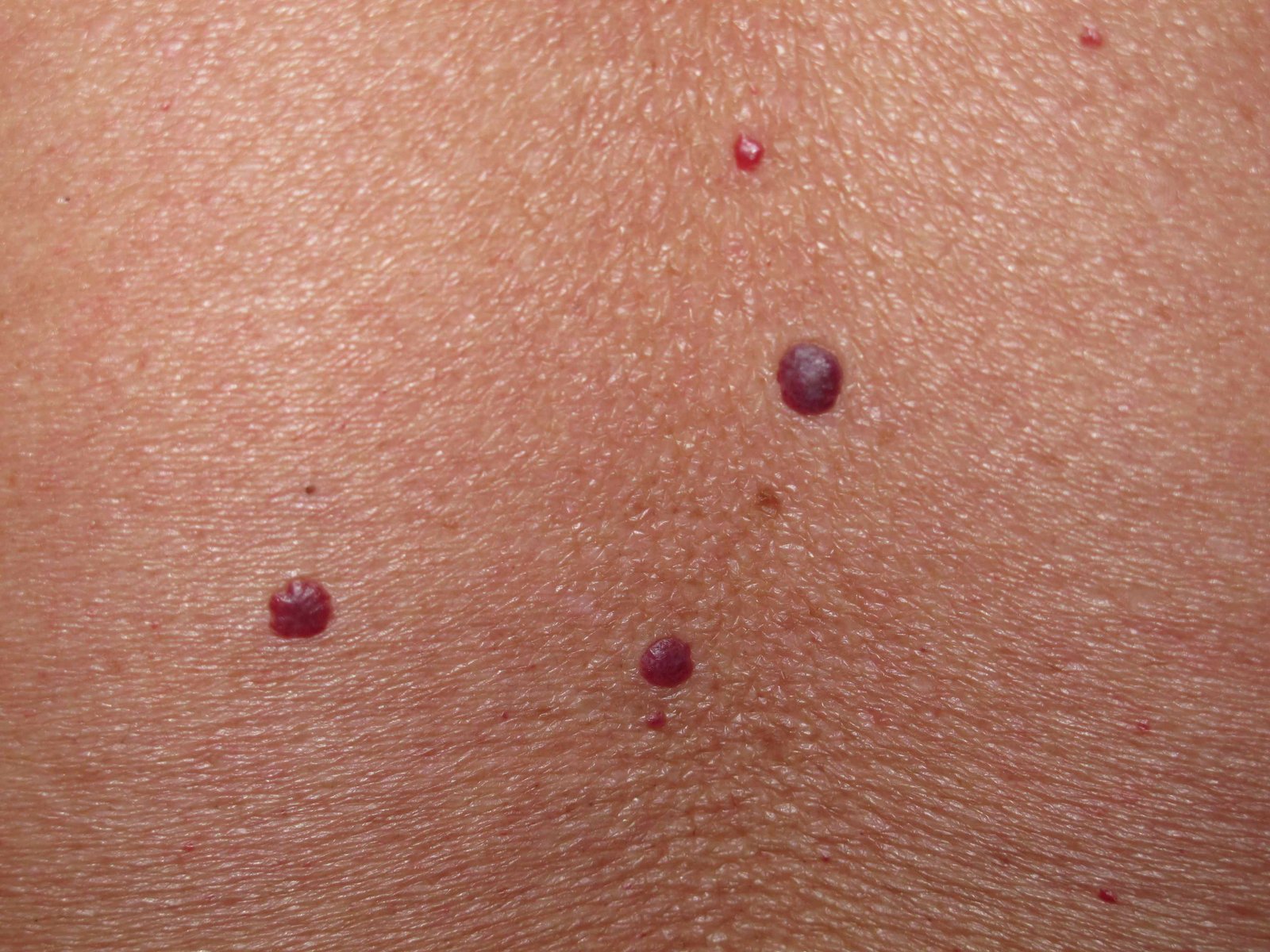
If you have them, surely you have already noticed but you keep asking, what do these red dots mean? How important are they? How do they differ from moles? Can they degenerate?
According to information collected by the specialists of Dermatologists in Mérida, most people from a certain age develop red dots or ruby points throughout the body. This pathology that is scientifically called acquired capillary angioma is of no importance and does not require treatment.
Within the aging process of the skin it is common and common to see the appearance of dark spots, warts, wrinkles and red spots.
Perhaps red dots are the most anguish and are not uncommon patients who consult us due to their presence.
Just as in the legs it is usual to be able to observe small veins that break (varicose veins) or clusters of veins that are disposed in a highly unsightly way on the thighs or around the knees or even thicker veins and marked (varicose veins) is not strange to observe this other type of vascular pathology in the trunk.
In fact, one and the other pathology are comparable. In the legs, the veins and capillaries tend to position themselves parallel to the skin while the trunk does so perpendicularly and that is why instead of a varicose vein we see a red dot.
The ruby points or red points are nothing but small capillary dilatations. They have no importance and there is no medical reason to treat them. Following, anyway, an aesthetic criterion, if someone is worried about their appearance they are very easily eliminated using a laser or an electro-fulguration device.
This should be the only reason that moves us to eliminate them, if they go out in places where they are very visible or in places where there is a lot of friction and irritation then it is very easy to burn them and make them disappear without leaving any type of scar or mark.
Vascular lasers, the YAG laser, the pulsed dye laser or even the IPL are useful to eliminate these imperfections. The electric scalpel or electro-fulgurator (EFG) is also a good alternative.
Normally the red spots appear on the trunk, on the belly on the chest and back and the number and age of appearance follow fairly familiar criteria.
If at home the father or mother had many, it is likely that we also have many. A bit like the gray hairs that we tend to look like our relatives in terms of the age of appearance and the amount of white hair.